 |
Years & Months AGE FINDING Challenge |
 |
| Aim Challenges Approach Example Compare Regular New Structure Summer Model Read Me |

Our Aim
Our modest question. "Given the birthday of our subject, as well as today's date, what is the age, in Years and Months, of our subject?" For a given subject, we aim for a result which enables us to compare the ages of different subjects in terms of years and months, while, at the same time, avoiding the complexities, in terms of the lengths of successive years and months, which the Gregorian Calendar and the Calendar based on Solar Time each throw at us.
Candidate Calendars & The Integer Day
To proceed, we need to choose a calendar on which to place our "Year-Month" (YM) system. Our reference is the day, with its well documented times for daylight and night. To our full day (comprising daylight and night), we can readily assign a time length - 86,400 seconds, or 1,440 minutes or 24 hours. Mechanical clocks, watches and time pieces have borne testimony to this throughout history, improving gradually in their accuracy.
There are a number of candidate calendars, but, as mentioned, the Gregorian Calendar (see also Gregorian - 2 ) and the Calendar based on Solar Time (see also Solar - 2 ) are first and known choices for most of us, and provide a suitable starting point for our investigations.
Challenges - Gregorian & Solar Time Calendars.
Easy, might be the answer. "Easy"? Well, let us consider the two calendar options we have chosen. There may be more, but, as mentioned, we shall try and keep things simple.
Gregorian Calendar (GC)
With the Gregorian Calendar (GC), there are leap years. This means that according to the Gregorian Calendar, it takes approximately 365.25 (365¼) days, averaged over four successive years, for the earth to go around the sun.In addition, for the GC, in the simplest situation, every four years there are:
- 4x7 Months with 31 days
- 4x4 Months with 30 days
- 1x Month with 29 days
- 3x Months with 28 days
Solar Year (Solar Time Calendar)
The Earth orbits around the Sun in 365 days, 6 hours, 9 minutes (365.24219 days per year). This is a non-human given. (See: tropical or solar year and Reference Systems: NASA). The NINE minutes amount to an extra day every 160 years.
If in doubt (!!) we can note that, since one day consists of 24 hours, each of 60 minutes, and we have an extra 9 minutes per year, this gives us:
(24x60 min)/(9 min/year) = 160 year
Which one to Use?
On which calendar, Gregorian (GC) or Solar, should we base our Year-Month (YM) calculator?
- ✓ Gregorian. We are familiar with the GC.
- ✓ Gregorian. The GC, importantly, accomodates integer days over a four year time scale.
- ✓ Solar. The modern incarnation of the GC tends to get "slightly ahead" of the Solar Year (SY). (The Gregorian Year finishes 9 minutes before the Solar Year.) The GC thus requires a further correction of one extra day every 160 years so as to "rein it in" in order not to get further and further away from the actual solar year (SY).
Decision
- We shall use a "simplified" form of the Gregorian Calendar (GC) on which to base our Year-Month (YM) calculator. The GC is familiar to us and the GC accomodates integer days over a four year time scale. "Simplified" means 12 months of equal time duration per year.
- We shall also assume that for every four years, the earth takes a total of (3x365 + 1x366) days, which is 4x9 minutes less than the actual value. Hence the need for an extra day every 160 years.
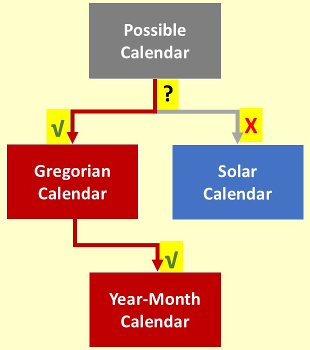
Decision Made!
A Possible Approach
To produce a reasonably tractable solution, we can make the following model for our proposed simplified calendar. This model is characterized by the following attributes and associated calculations.
Year-Month Calendar - A Simplified Calendar
- All years have 365.25 days.
- Each year has 12 months of equal time length.
- Hence, each month has (365.25/12) days or exactly 30.4375 days.
Calculation
- DAYS. Spread sheets such as Microsoft's® Excel® can give the difference, in days, between todays's date and the birth date of our subject. Further details below, in point 2 of Comments on Days.
- YEARS. Divide the days - referred to just above - by 365.25, and round down to the nearest integer, to give the subject's age in years.
- MONTHS. Take the remainder and multiply by 12, and remove the remaining fraction - however large or small - of a month. Removing the fraction, not only fits in with perceived practice, but importantly, also aims to avoid the situation where we might otherwise get a result (e.g.) such as 7 years and 12 months.
Result
- This is in Integer Years and Integer Months.
- This result will normally be within one or two percent of that obtained via the current (uneven) Gregorian Calendar! (See the two blue spread sheets in the Comparison Section below.)
Example
In the example, just below, we have entered the current date (13/07/2025) together with the birth dates of each of our subjects - their names courtesy of Shakespeare! The spreadsheet gives us the age in days of each of our four subjects. For each subject, dividing the total number by the days (365.25) in the year, we get the number of years. The remainder is a decimal fraction; this is multiplied by 12; the result, by perceived convention, is rounded down to the nearest integer, to give us the months!
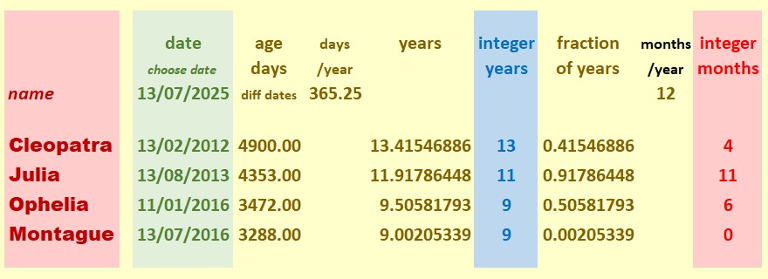
Example Using Shakespeare's Heroines and Heroes.
(Actually names of priviledged canines)!
The advantage of the "Year-Month" (Y-M) approach presented here is that the implementation of the Y-M model starts immediately at the birthdate of the subject, and not on a 1st January. At the same time the Y-M approach accommodates the accepted four yearly frame of the Gregorian Calendar, while its simplified month structure avoids the complexity of the month structure of the traditional Gregorian Calendar.
Comparing Year-Month & Gregorian Calendars
The Year-Month (YM) Calendar allows us easily to compare ages of different subjects in terms of years AND months. How close is the Simplified Year-Month Calendar to the Gregorian Calendar? We have two aspects: the calendar models (YM and GC) and their numerical relation.
- The calendar model for the Year-Month calendar- red characters on a pink background.
- The relation between the Gregorian and the Simplified Year-Month calendars - blue characters on a light blue background.
Every Four Years
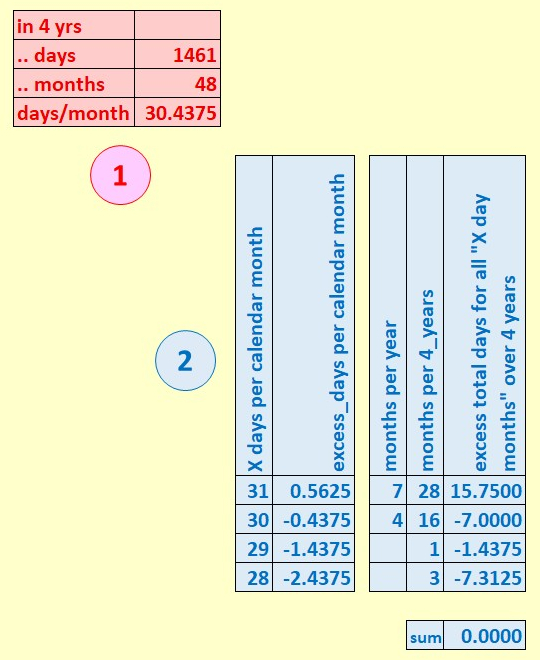
Calendar Model for the Y-M Calendar, and the relation between
the Gregorian and the proposed Simplified Year-Month calendars.
Simplified, in order to readily evaluate a subject's age in years and months.
Every Year
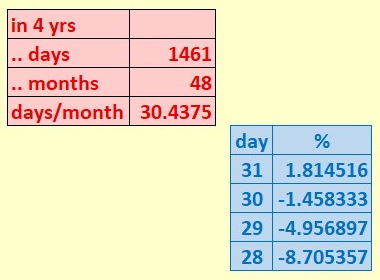
Relation of Gregorian Months to those of the Simplified Year-Month Calendar.
The day lengths of all Gregorian months, except February,
are within ± 2% of the Simplified Calendar.
Days & Regular Change
Here we look at the issues of regularity as well as availability of the number of days or smaller time entities.
Regularity of Change
Days normally change in a simple and regular manner, unlike the years and months which are the features of our Gregorian Calendar. However, the years and months, with their varying lengths of days, comprise our traditional Gregorian Calendar. The years and months are made of days as component entities.
Time quantities which increment in a simple and regular manner, include, apart from days, also milliseconds, seconds, minutes and hours. This is unlike the years and months which are the features of our Gregorian Calendar.
Availability
Here we look at the availability, in a calculation context, of the number of days or smaller entities.
- Spread Sheets. As stated above, spread sheets such as Microsoft's® Excel® can readily give the difference, in days, between todays's date (current date) and the birth date of our subject.
- Languages such as Javascript® can even give the time difference in milliseconds.
- Other. The number of days between the birth date of our subject and today's date, could also be found manually or by a hand coded program.
Simplified Structure - Year-Month Approach
We have suggested that things are not necessarily as straight forward as they as might at first appear! Indeed, using our current Gregorian Calendar (see Make Your Own Calendar) to find a subject's age in terms of years and months would involve tracing back from the current date through years and months of varying length of days.
The Year-Month (YM) method, as presented here in this web paper, presents a simplified version of the Gregorian Calendar (GC). The YM method postulates a simplified calendar structure, with:
- Years of equal length of 365.25 days per year and
- Months of equal length of 30.4375 days per month.
Compared with the GC, the YM Approach offers the following advantages.
- Age Determination. It enables us determine easily (e.g. with a spreadsheet) the age in years and months of a subject, starting from today's date and ending at the birthdate of the subject.
- Age Comparison. It allows allows ages of different subjects to be easily and readily compared.
- Years of Equal Length. It avoids the need to be concerned by the varying length of years.
- Months of Equal Length. It avoids the need to be concerned by the varying length of months.
The Solar Calendar, although marginally more accurate in terms of the transit time of the earth around the sun, interferes with the accepted time length of a day, and indeed, successive days. Hence, it makes sense to stay with the easily manageable 365.25 days per year with the leap year system and its occasional adjustments.
Of course, all this is on the assumption that the the earth is maintaining its speed around the sun and the rotational speed on its axis! Any changes in this regard are considered as imperceptible to us mere mortals - at least over the next few centuries!
BST and Birthdates
British Summer Time (BST) is introduced for daylight saving. From UTC (GMT), the clocks spring foward by one hour in the spring and fall back by one hour in the fall. In the wartime (WW1 and WW2) the time difference was as much as two hours. The change over occurs between 2am and 3am in order to minimise disruption.
My source of dates does not consider if subjects who were born during BST, were actually born in the hour between midnight and 1pm. In theory, the birthdates, as given according to UTC, for these subjects, are too young by one day! The probablity (1 in 24) of being born between midnight and 1pm, or between the 2am to 3am changeover time, or indeed of the correct reporting of either event, would appear to be negligible in practice. Corrective action, if possible, would amount to just one day, but the consequent complexity, work and time involved, indeed favour the ignoring of the effect of BST on the number of days since the subject's birth.
Essentially, for simplicity, for the Y-M Calendar Model, I shall ignore Summer Time!
Final Simplified Calendar Model
☆ Two main ingredients ☆
- UTC/GMT. Universal Time Coordinated (UTC) (the old GMT) is used but Summertime (BST) is ignored.
- Years & Days. There are exactly 365.25 days per year and each year consists of 12 months, each month of exactly 30.4375 days.
Acknowledgement
I would like to thank especially the hounds of my neighbour. The quest for a reasonably simple, but acceptable way, to find their ages prompted the investigations you see laid out on this page.
Dolly, Daisy, Effie and Chester (Chechache)
Many Thanks Indeed!
A Hearty Woof Woof to you All!
Also, Dear Reader
Thank you for your interest and attention!

Original: 2025-07-08 @20:39
Latest: 2026-08-22 @13:14
SAGAX REX HANC RETIS ORBIS PAGINAM PINXIT ANNO MMXXV
© Eric Scharf 2025